Key Takeaways
- Mathematical Rarity: A sequence is statistically harder to achieve than a color, which is why it holds a higher rank in the game.
- Standard Hierarchy: In the official teen patti rules, the ranking order places Sequence (Straight) above Color (Flush).
- The Poker Confusion: Many players get confused because, in Texas Hold’em, a Flush beats a Straight, but the 3-card math of Teen Patti reverses this.
- Pure Sequence vs. Normal Sequence: Always remember that a Pure Sequence (Straight Flush) remains the second-highest hand, trailing only a Trail/Set.
- Strategic Edge: Understanding these hand rankings is crucial for making better betting decisions and managing your “Chaal” effectively.
Teen Patti is more than just a game of luck; it is a cultural staple in India, bringing life to Diwali nights and family gatherings.
Whether you are playing on a physical table or practicing your skills on https://tpmaster.in/, one question almost always pops up among beginners: “Why does a sequence beat a color?”
If you have played Poker before, this might feel counterintuitive—and honestly, I’ve seen this trip up even seasoned card players.
In most 5-card poker variants, a Flush (Color) is considered a stronger hand than a Straight (Sequence).
However, Teen Patti follows its own logic, rooted deeply in the mathematical probability of a 3-card hand.
To master the game, you need to look past the cards and understand the math that dictates the teen patti card sequence.
The Basics: Defining Sequence and Color
Before we dive into the “why,” let’s clarify what these hands actually are.
In the world of Teen Patti, these two hands are the mid-to-high tier powerhouses that often determine the winner in a high-stakes pot.
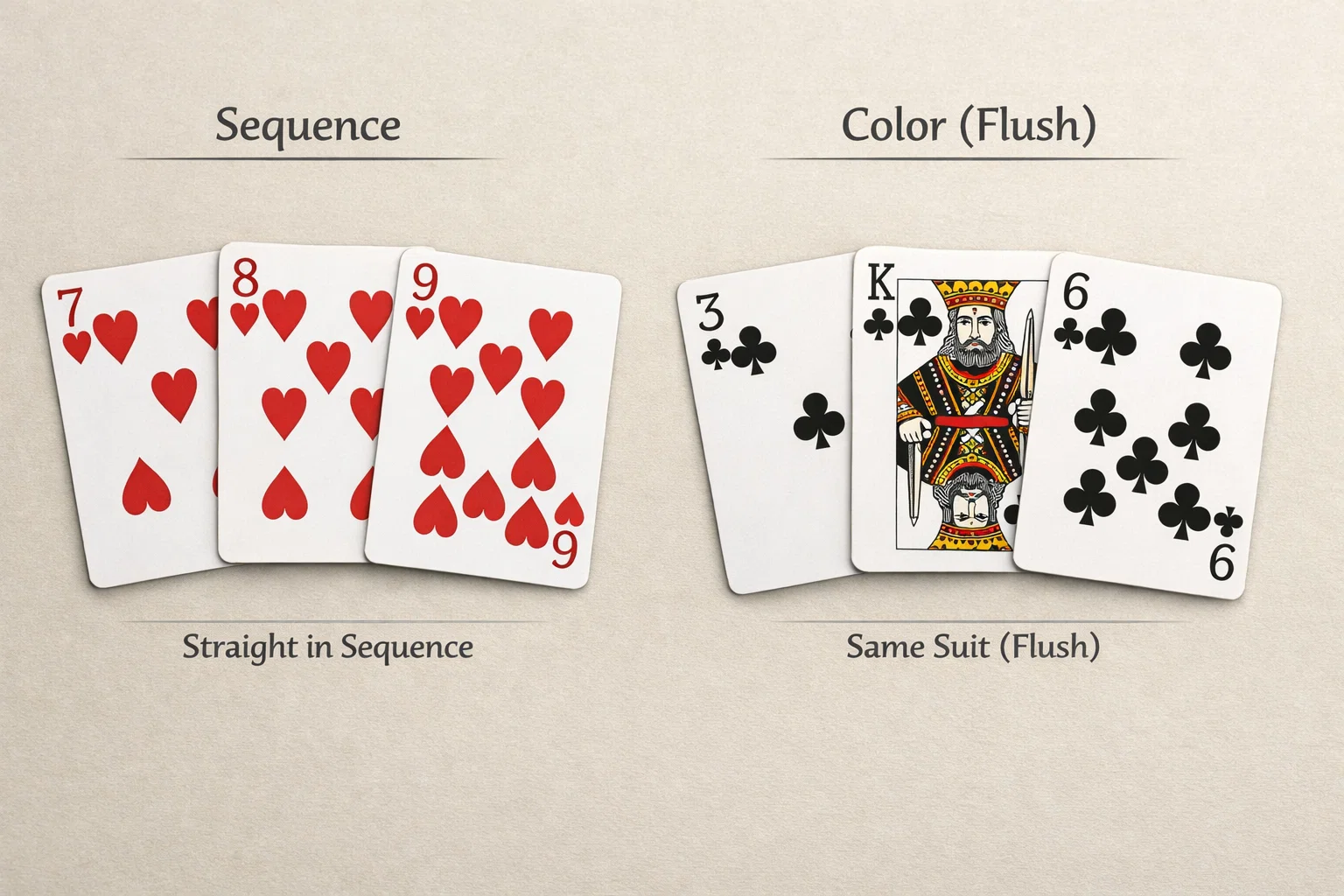
A Sequence, also known as a Straight, consists of three consecutive cards that are not all from the same suit.
For example, a 4 of Hearts, 5 of Spades, and 6 of Diamonds. This hand relies entirely on the numerical order of the cards.
A Color, widely known as a Flush, consists of three cards that belong to the same suit, but are not in a numerical sequence.
For instance, a King, 7, and 2, all of Clubs. Here, the numerical value is secondary to the symbol on the card.
The Official Teen Patti Hand Ranking
To play effectively, you must have the hierarchy memorized—this is non-negotiable if you want to avoid costly mistakes.
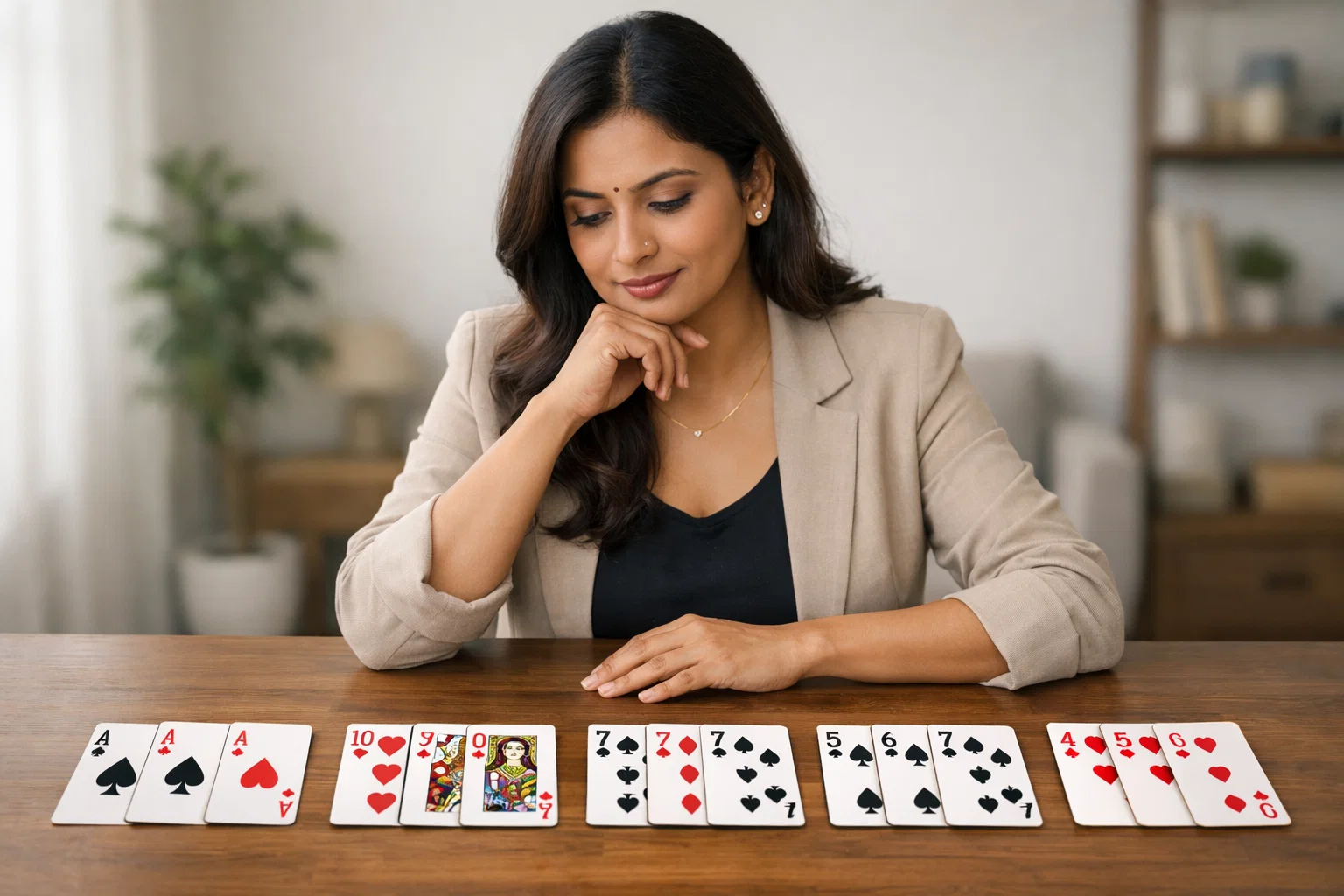
The official teen patti card game rules rank hands from highest to lowest as follows:
- Trail or Set (Three of a Kind): Three cards of the same rank (e.g., three Aces).
- Pure Sequence (Straight Flush): Three consecutive cards of the same suit.
- Sequence (Straight): Three consecutive cards of different suits.
- Color (Flush): Three cards of the same suit, not in sequence.
- Pair (Two of a Kind): Two cards of the same rank.
- High Card: The highest-ranking card in a hand that doesn’t fit the above.
Notice that the teen patti sequence sits comfortably at the third spot, while the color follows at fourth.
This is the gold standard of the game, though I should mention that some informal home games may have slight variations—always confirm rules before chips hit the table.
Why the Ranking Favors the Sequence
The most logical way to explain this is through probability.
In any card game, the harder a hand is to get, the higher it ranks.
In a standard 52-card deck, the number of ways you can form a 3-card hand is significantly lower than a 5-card hand, which changes the math entirely.
When you calculate the possible combinations for a 3-card draw, you find that there are fewer ways to land a sequence than there are to land a color.
Specifically, there are 744 possible combinations of a Sequence, whereas there are 1,096 possible combinations of a Color (excluding Pure Sequences).
That’s nearly a 47% difference—which is pretty substantial when you think about it.
Because the teen patti card sequence is rarer, it is rewarded with a higher status.
If Color were ranked higher, the game would become unbalanced because players would be winning with a hand that is statistically easier to obtain.
Teen Patti vs. Poker: The Great Divide
If you are coming from a Texas Hold’em background, your brain is probably screaming that a Flush should beat a Straight.
This is, in my experience, the biggest hurdle for new players learning the teen patti rules.
In Poker, you are usually dealing with 5-card combinations out of 7 available cards.
In that specific format, hitting five cards of the same suit is much harder than hitting five cards in a numerical row.
However, Teen Patti is a 3-card game.
The moment you drop the requirement from five cards to three, the mathematical difficulty flips.
It is much easier to find three cards of the same suit than it is to find three cards that follow a perfect 1-2-3 numerical order.
This is the fundamental reason why the teen patti game rules differ so sharply from international poker standards.
Common Myths and Newbie Mistakes
One of the most frequent mistakes “Newbies” make—and I’ve watched this happen countless times—is overestimating their Color hand.
They see three Hearts in their hand and think they are invincible, only to be cleaned out by a player holding a simple 2-3-4 off-suit sequence.
“But my Color has an Ace!” is a common complaint.
While an Ace-high Color is a strong hand, it still loses to the lowest possible Sequence (which is usually 2-3-4 or A-2-3 depending on house rules).
Many players learn this the hard way.
Another myth is that the “Suit” matters in a sequence.
In the standard teen patti card sequence, the suit only matters if you are going for a Pure Sequence.
If two players both have a normal sequence, the winner is determined by the rank of the cards, not the suit.
For example, A-2-3 beats K-Q-J.
Variations and How They Change the Rules
While the standard rules are consistent across most platforms like https://tpmaster.in/, some variations can flip the script.
It is always important to check the specific “Variation Rules” before you start betting your chips—I can’t stress this enough.
In Muflis (Lowball), the entire ranking system is inverted.
In this version, the weakest hand becomes the strongest. Therefore, a High Card would beat a Trail, and a Color would actually beat a Sequence because the Color is a “stronger” (and thus “worse” in Muflis) hand.
In variations like AK47 or Joker, where certain cards act as wildcards, the ease of forming a sequence increases.
However, the standard hierarchy usually remains the same to keep the gameplay consistent for the players—though platform-specific rules can sometimes surprise you.
Practical Understanding for Your Next Game
Knowing the rank is one thing; using it to win is another.
When you are playing, you need to assess the “Texture” of the game. If the betting is aggressive (many players going “Chaal”), the chances of someone holding a sequence or higher are very high.
If you are holding a Color, you should play with caution.
It is a “gatekeeper” hand—strong enough to beat pairs and high cards, but vulnerable to anyone holding a sequence.
If you are playing “Blind,” and you see your cards to find a sequence, you are in a very strong position to dominate the round.
Always remember that in Teen Patti, confidence is as important as the cards.
Even if you don’t have the sequence, playing as if you do can often force players with better hands to fold.
But to bluff effectively, you must first know exactly what you are pretending to have!
Summary of the Battle: Sequence vs. Color
To wrap it up, the sequence wins because it is a mathematical underdog. It shows up less often, making it more valuable.
- Sequence (Straight): Harder to get, ranks 3rd.
- Color (Flush): Easier to get, ranks 4th.
- Key Logic: Probability dictates the power.
The next time someone at the table tries to argue that their three Clubs should beat your 7-8-9 mix, you can confidently explain the math to them.
Or, better yet, just collect the pot and let the rules speak for themselves.
If you’re looking to sharpen your skills and put this knowledge to the test, visiting https://tpmaster.in/ is a great way to engage with the community and understand the nuances of the game even better.
About the Author
Ishaan “The Dealer” Sharma
Ishaan is a professional card game analyst and veteran strategist with over 15 years of experience in the Indian card gaming circuit. Based in Delhi, he has competed in high-stakes teen patti tournaments and has contributed extensively to the evolution of teen patti strategy guides. When he isn’t analyzing the latest 3 patti variations, he can be found exploring the intricate bidding mechanics of the 29 card game.